



Solar panel for recharging cameras : How does the SP21 Solar Panel work?
When you go hiking, on a road trip, on a bivouac or when you're simply far from an outlet, we all ask ourselves this question. How can you recharge your phone, camera or still camera without relying on a battery that runs down too soon?
Well, why not buy a solar recharging panel? It provides a very practical answer by capturing the available light, transforming it into useful energy and then recharging your devices throughout the day. It's not a ‘miracle’ solution that charges at the same speed everywhere. On the other hand, it is a simple, practical and reassuring solution when you want to keep your equipment available.
AgfaPhoto offers you the Solar Panel SP21 for all your travels. It is designed for nomadic recharging, with a portable format, outputs adapted to small devices and a power level designed to accompany days outdoors.
How does a solar panel work and what can it power?
Before talking about power and charging time, it's important to understand what a solar panel does in the field. It doesn't ‘fill’ a battery like a wall socket. It supplies energy that varies according to the light, orientation and use you make of it. Once you've got that down, everything becomes much simpler to use.
How can I recharge my battery with solar panels?
The way it works is fairly straightforward. The panel captures the light. It converts it into electricity. Then it sends this energy to your device via a suitable USB or DC output.
In practice, you plug in your phone, camera or camera battery charger, just as you would an external battery. The difference is that the “source” depends on the sun. If you move the panel, if a shadow passes, if the sky becomes overcast, the charge can slow down.
The cable is very important. A cable that is tired, too long or of poor quality can limit charging. Conversely, a reliable, well-connected cable avoids micro cuts.
Another reflex helps on a daily basis. Charging one appliance at a time is often more efficient, especially when the light is average. You start with the most urgent item, then move on to the next. This is often more stable than spreading the power over several devices at the same time.
What can a 20 W solar panel power? Can a 20 W solar panel recharge a phone?
With a power level of around 20 W, we're talking about realistic nomadic uses. The panel is mainly used to recharge mobile devices and extend their autonomy during a day out.
In practical terms, it can be used to recharge a phone, a tablet, a camera, a compact camera via its charger, or a small external battery. It can also power small USB accessories, such as a USB camping light or a small pocket fan.
However, it's important to distinguish between two words that sound alike. Powering means making a device work directly. Recharging means filling up a battery for later use. Outdoors, we usually talk about recharging, because it's simpler and more stable.
Finally, for larger portable power stations, we change categories. Some can accept a solar charge, but they often require more power to be really effective. For this type of need, a more powerful panel is generally more comfortable.
Can a solar panel work without sunlight?
Without light, no. A panel needs a light source to produce energy.
However, it can work with diffuse light. On a cloudy day, it still produces, but less. In the shade, power falls sharply, especially if part of the panel is hidden. And at the end of the day, recharging becomes slower as light intensity decreases.
Here's a case in point for everyone. You're in a forest, with sunlight coming through between the branches. Charging can start, slow down and resume, depending on the area. In this context, the best reflex is to take advantage of well-exposed moments, such as a clearing or a break at the side of a path, to optimise charging.
What is the charging power of the SP21 and how can you use it on a daily basis without getting into trouble?
When you use a solar panel outdoors, the comfort comes from two things in particular. Knowing what you have in your hands, and taking two or three simple steps to optimise recharging. The SP21 has been designed with this in mind, with its foldable format, clear outputs and consistent power output for everyday devices.
What is the best solar charger in 2026?
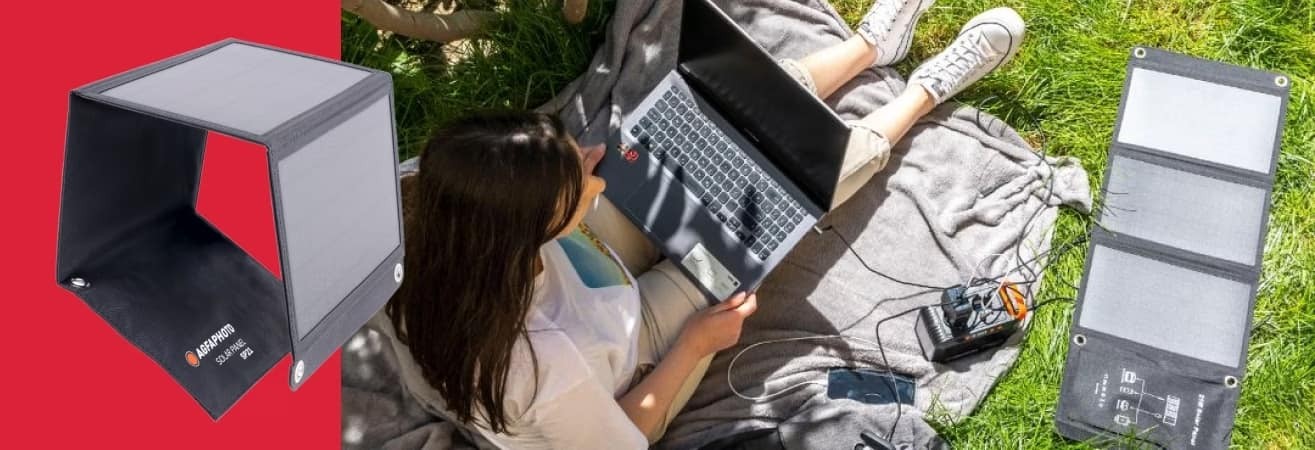
The AgfaPhoto Solar Panel SP21 is a foldable solar panel made up of three panels. When closed, it is easy to store. When open, it offers a larger surface area for capturing light.
The kit includes DC adaptors, a 2-metre DC cable, carabiners and a manual. In real life, these accessories count. The carabiners allow you to hang it on a bag while walking or secure it on a rock while camping. The 2-metre cable means you don't have to stick the phone to the panel, giving you more freedom to put the phone down in the shade while the panel is in the sun.
The foldable side also helps to adapt to the terrain. You can open it all the way when you're sitting down. Or deploy it partially if you have less space. It's this format that makes nomadic use more natural. It's definitely one of the solar charging panels of 2026, thanks to its reasonable price and clever features.
What is the charging power of the SP21 solar panel?
The SP21 claims a total output of 21 W, with three 7 W panels. Put like that, it's technical information. In practice, it means that it has enough margin to recharge mobile devices. But you have to give it the right conditions.
Real power depends much more on exposure than on the figure alone. A perfectly oriented panel in full sunlight charges better than a more powerful panel in the wrong position. Partial shade can also reduce charging, even if the rest of the panel is in the sun.
So the best thing to do is to think in terms of ‘clean light’. If in doubt, move the panel thirty centimetres. Sometimes that's all it takes to get a more stable charge.
The SP21's two outputs, USB and DC: when to use which one?
The SP21 has two outputs, one USB and one DC. The 5 V USB output is used for smartphones and most small devices that charge in the same way as a conventional plug. It's the most instinctive choice, especially when you're on the move.
The 18 V DC output is for compatible devices, depending on the cable and adapter used. This is typically useful when you're recharging a camping-specific device, or when you want a more direct connection to equipment designed for this type of input.
A concrete example helps to illustrate. While walking, you charge a phone via USB, because it's simple and universal. Once you've reached the spot, you can switch to the DC output for a compatible device, while the phone rests in the shade.
How do you place a solar panel?
The most effective method involves a few simple steps. Start by orienting the panel towards the sun. If the sun moves, adjust it once or twice during the day, especially in the early afternoon when the light is strongest.
Avoid partial shade. A branch, a strap or a corner of a jacket may be enough to reduce the load. A fully shaded panel is better than one that is half-shaded.
Depending on the terrain, you can lay it flat or tilt it. If you have a stable surface, tilting it towards the sun often improves collection. And if the wind picks up, secure it with the snap hooks to prevent it from closing or moving.
Finally, check the cable before you start charging. An incorrectly inserted connector can give the impression that ‘it's not charging’, when in fact the panel is producing. A quick check at the outset avoids this kind of frustration.
Charging time and mistakes not to be made
When you're looking for a solar charger, you're mainly looking for a solution that suits your terrain. A day's hike, a bivouac, a road trip or a photo weekend don't have the same constraints. The good news is that with a few simple criteria, you'll soon know whether a panel will be useful or end up at the bottom of your bag.
How long does it take to charge a camera battery using a solar panel?
There's no magic time, because it all depends on four things.
Firstly, the capacity of the battery. A small battery recharges faster than a large one, obviously. Secondly, the charger used. Some photo battery chargers are more efficient than others. The weather also counts. In bright sunlight, charging is more stable. Under a cloudy sky, it works, but more slowly. Finally, there's the way you charge. Directly from the camera's battery, or via an external battery that you fill in the sun and then use.
Here's a simple example. During a lunch break, you put the panel down facing the sun and recharge either an external battery or a device. On a road trip, when stationary, you can deploy it on the dashboard or outside near the car, avoiding shadows. When bivouacking, the idea is often to take advantage of the best hours of light to fill up a reserve of energy, then recharge quietly in the evening. To estimate your needs, it also helps to understand the units, particularly the difference between W, Wh, Ah and mAh.
Common mistakes that lead people to believe that a panel ‘doesn't work’.
The first mistake is shade. Even partial shade. A strap, a branch, a corner of a jacket and the charge can drop.
The second mistake is using it behind glass. You think you're in the sun, but performance often drops. And you end up with a very slow charge.
Thirdly, the cable. A poor quality or badly connected cable is enough to cause micro cuts. You think the panel is to blame, when it's really just an unstable connection.
Another common pitfall is a phone that heats up. Some models deliberately limit charging to protect themselves. You have sunshine, you have a panel, but the phone decides to slow down.
Finally, there's the case of the device that's too greedy. Charging several devices at the same time, or powering equipment that requires a lot of energy, can give the impression that ‘things aren't moving’. At such times, charging just one appliance, then moving on to the next, often gives better results.
Can it be used to charge a portable power station?
Yes, but it's important to distinguish between uses. The SP21 has been designed to charge mobile devices via its USB and DC outputs. So we're talking about charging phones, tablets, cameras or external batteries on the move.
For a larger portable power station, the needs are often in a different category. The station can sometimes accept a solar input, but comfort of use depends above all on the power available. In this case, we generally opt for more powerful panels, because otherwise charging takes a very long time.
Solar Panel SP21: simple recharging when you want to remain autonomous
A solar panel for recharging becomes really useful as soon as you move away from sockets. It doesn't replace a wall socket in a hurry, but it does provide valuable autonomy in the field.
You can recharge as the day goes on, avoid running out of power and keep your equipment available to capture the good times.
The SP21 makes a real difference. A total power of 21 W, a foldable format that's easy to carry and two outputs to adapt to everyday use. With a few good gestures, good orientation, zero partial shading and a reliable cable, you'll get a more stable and more pleasant recharge every day.