



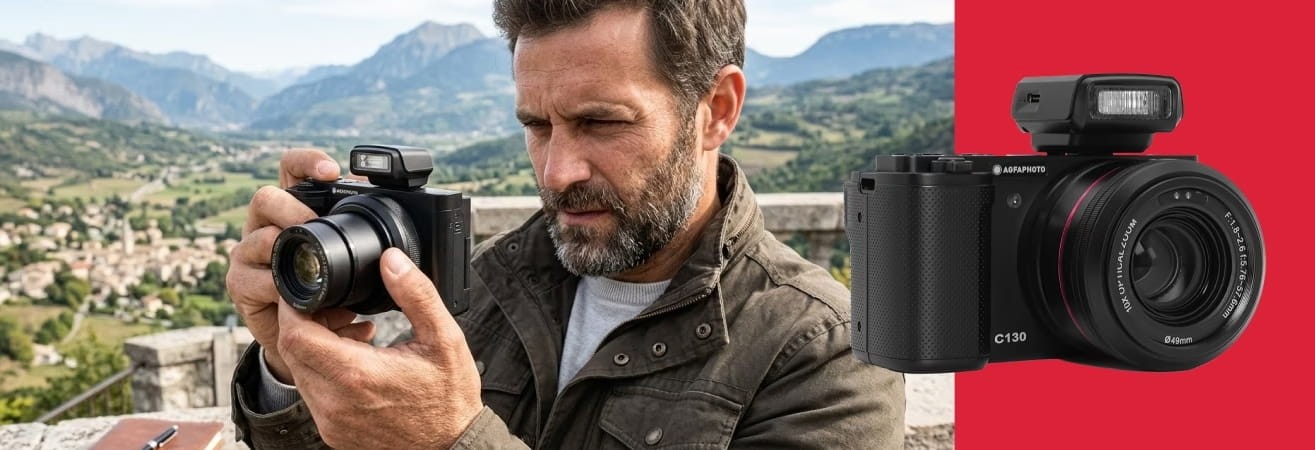
What is an optical zoom actually used for ?
When you're choosing a camera, the term optical zoom almost always appears in the specification sheet. 5x, 10x, sometimes more. These figures catch the eye, but they often remain abstract. We know that it allows us to ‘zoom in’. We know that it brings the subject closer. Yet few people really know what difference this makes to a photograph.
Optical zoom plays a very important role in image quality. It is more than just an enlargement. It changes the framing, the perspective and the way the subject fits into the scene. It allows you to photograph a detail without losing sharpness. It also helps to compose an image with greater precision.
Let's take a look at how optical zoom works, its qualities and how to use it.
What is optical zoom and how does it work in practice?
Optical zoom is often summed up as a simple number. However, behind this term lies a truly advanced optical mechanism. To use it properly, you need to understand what it actually does in your camera and how it works.
Let's try and put some clear words to a technical concept and show how it changes things in the field.
What is an optical zoom?
The optical zoom is a mechanical system built into the camera lens. When you zoom in, the lenses physically move inside the camera. The image is enlarged without being degraded.
That's the difference with digital zoom. Digital zoom enlarges a portion of the image using software. It crops and stretches the pixels. An optical zoom, on the other hand, actually brings the subject closer thanks to the movement of the lenses. But we'll go into more detail about this a little later.
In practice, this changes a lot of things.
For a portrait, you can frame more tightly without losing sharpness.
For a landscape, you can isolate a detail in the distance.
For an animal at a distance, you can capture the scene without getting too close.
By understanding what an optical zoom is, you can make a better choice of camera and avoid confusing real quality with simple digital enlargement. To take this a step further, it is useful to link this concept to that of focal length and angle of field, two fundamental concepts in photography.
How does optical zoom work?
In practical terms, optical zoom is based on the movement of several lenses inside the lens. These lenses are not fixed. They slide in relation to each other when you activate the zoom lever or the dedicated ring.
This movement changes the focal length. The focal length is the distance between the optical centre of the lens and the sensor. It is expressed in millimetres. It is this value that determines the portion of the scene captured.
When you increase the focal length, for example from 24 mm to 70 mm, the angle of view narrows. The camera “sees” less, but further. The subject takes up more space in the image. This is not just a software enlargement. The lens is really capturing a narrower portion of the scene.
Conversely, a short focal length such as 24 mm offers a wide angle of view. It allows you to include more elements in the frame. This is ideal for a landscape or a group photo.
You can compare it to the human gaze. Imagine looking at a landscape through a window. If the window is large, you see lots of elements around it. If you look through a narrow tube, your vision focuses on a precise detail. Optical zoom works in much the same way.
This change of focal length also influences perspective and the sense of distance between elements. At long focal lengths, planes appear closer together. At shorter focal lengths, depth appears more pronounced.
Let's take a concrete example with the Realishot DC9200, whose specification sheet lists a 10X Optical Zoom, 24MP photo resolution and built-in stabilisation.
In the field, a 10X zoom means you can photograph an architectural detail at height or a distant subject without moving. To optimise rendering, a few settings are essential. Activating anti-shake limits microblur when zooming in strongly. Adjusting the ISO according to the light helps to maintain a clean image. Slightly correcting the exposure helps to avoid a scene that is too dark or too bright.
The optical zoom does not act alone. It works with the sensor, the stabilisation and the settings chosen on the camera.
How many mm is a 2x zoom?
The 2x factor simply means that the focal length is doubled. If your lens starts at 24 mm, a 2x zoom will correspond to 48 mm.
These millimetres are important for understanding the angle of view. At 24 mm, the image is wide. At 48 mm, the frame narrows. The subject takes up more space in the image without you having moved.
Knowing how to read millimetres makes it easier to anticipate the final result. It's not just a question of marketing figures. It's a compositional tool. By mastering the focal length, you can control the apparent distance between the subject and the background and compose a more precise image.
The optical zoom then becomes a real creative lever, accessible as soon as you understand how it works.
Optical zoom VS digital zoom
When we talk about optical zoom, we inevitably make the comparison with digital zoom. Both zoom in on a subject. However, the way they work and their impact on the image are very different.
This distinction is essential if you want to make an informed choice about your camera.
What is the difference between optical and digital zoom?
Optical zoom is based on real lens movement. The lens physically moves to change the focal length. The subject is actually brought closer even before the image reaches the sensor. Quality is therefore preserved.
Digital zoom works differently. It crops the image captured by the sensor and then enlarges it using software. A portion of the photo is enlarged. This leads to a loss of sharpness, especially when zooming in strongly.
The final quality depends very much on the sensor and the megapixel used. A high-performance sensor will offer more margin, but the principle remains the same. Digital zoom enlarges existing pixels. It does not add any real detail.
This is where optical zoom comes into its own. It retains precision and sharpness, even when the subject is far away.
Take the Realishot C110 Ultra Wide Angle. Its 3X optical zoom lets you switch from a wide-angle shot to a tighter one without degrading the image. This versatility is invaluable when travelling. You can capture a wide landscape, then zoom in on a detail of an ancient temple, while maintaining consistent quality.
So the difference between optical zoom and digital zoom is not just a technical detail. It has a direct influence on the final result.
Is optical zoom worth it?
It's a question worth asking, especially in this age of high-performance smartphones.
When travelling, an optical zoom lets you photograph a monument without getting too close. In portraiture, it helps you frame your shot more closely and create a more natural blurred background. For sports or wildlife photography, it allows you to capture the action from a distance without any loss of quality.
Stabilisation is also invaluable. The more you zoom in, the more movements are amplified. A camera with effective stabilisation limits the blur caused by camera shake.
To give you a concrete idea, the Realishot C130 features a 10X optical zoom, an f/1.8 to 2.6 aperture and image stabilisation. This combination offers real creative freedom. The aperture lets you manage depth of field. The shutter speed helps to freeze movement. ISO can be adjusted according to the ambient light.
With these settings under control, the optical zoom allows you to get a perfect image as soon as you take the shot. This reduces the need for retouching afterwards.
So optical zoom is well worth the investment if you want to retain control over quality and composition. It provides real flexibility in the field and allows you to make the most of your camera's capabilities.
How do you set the optical zoom on your camera?
Understanding optical zoom is the first step. Knowing how to use it correctly is where everything changes. In the field, a few simple adjustments can help you get the most out of your camera.
How do you use and set up your optical zoom properly?
When you zoom in, movements are amplified. Stabilisation should therefore be activated. It reduces micro-shake and improves sharpness.
The ISO setting should be adapted to the ambient light. In daylight, a low setting is sufficient. Indoors or at the end of the day, it may be necessary to increase it slightly to maintain the correct shutter speed.
Shutter speed is essential when the subject is far away or moving. The more you zoom in, the more care you need to take to avoid blur. A faster shutter speed allows you to freeze the action.
Continuous autofocus is recommended for sports and video. It adjusts focus in real time as the subject moves.
White balance also deserves your attention. It guarantees natural colours depending on the lighting environment.
For video, these settings are even more important. The Realishot VLG4K OPT features a 5X optical zoom and a flip-up 3" LCD screen. It films in 4K and has adjustable ISO and exposure settings. When on the move, it's best to zoom in gradually and avoid sudden changes. Active stabilisation and good lighting make the image more fluid and pleasant to look at.
With the right settings, optical zoom becomes a real asset, for both photography and video.
Optical zoom and creativity: how far can you go?
Optical zoom is not just about bringing a subject closer. It transforms the way you compose an image.
In portraiture, a longer focal length naturally detaches the subject from the background. The features are more harmonious. The image appears more balanced.
In sport, the zoom helps to capture a precise gesture without entering the field. You capture the action at the right moment, while keeping a safe distance.
In nature, it allows you to observe and photograph without disturbing. An animal stays in its environment. You remain discreet.
In video, the optical zoom gives rhythm. It can accompany a movement or highlight a detail.
But there's one thing to bear in mind. Zooming is not always a substitute for movement. Physically moving closer changes the perspective. Zooming changes the framing, but not the position.
Knowing how to alternate between the two opens up more creative possibilities.
The optical zoom then becomes a visual storytelling tool. Used properly, it enriches your images and gives you greater control over what you choose to show.
The optical zoom: a real lever for progress in photography
Optical zoom has a direct influence on image quality, framing and creative freedom. It allows you to bring a subject closer without sacrificing detail. It gives you greater flexibility in the field.
Understanding the difference between optical zoom and digital zoom changes the way you choose your camera. Understanding focal length also changes the way you compose a photo. And knowing how to set up your camera means you can make the most of its capabilities.
Whether you're travelling, shooting portraits, sports or video, optical zoom brings real value. It means you don't have to rely solely on cropping or retouching afterwards. It gives you more precise control from the moment you take the shot.
Ultimately, optical zoom helps you to photograph with more intention. It helps you to frame better, to isolate a subject better and to tell the story of a scene more accurately.