



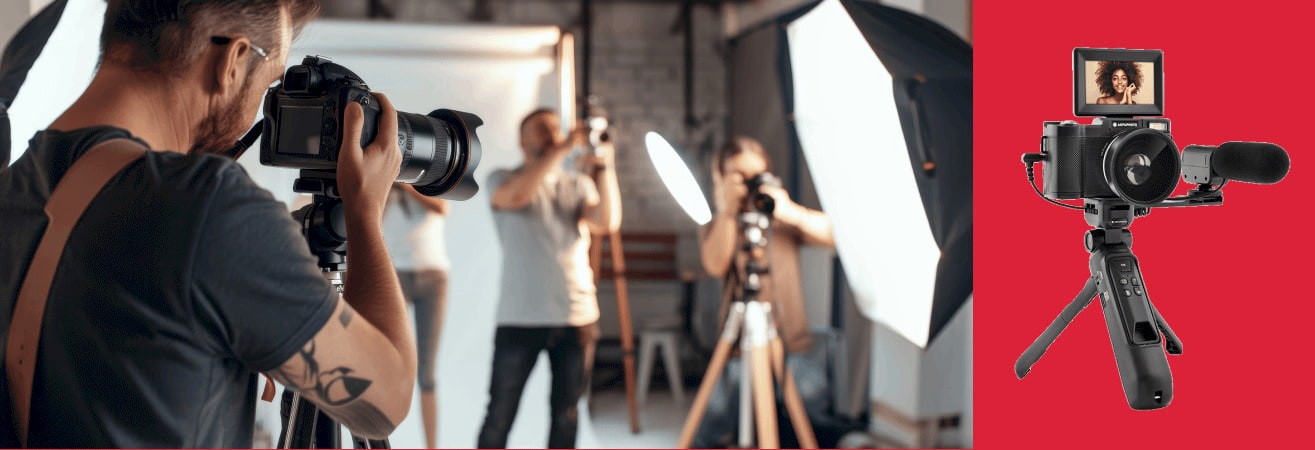
Camera tripod : How to choose one ?
Taking a good photo is sometimes a question of stability. Even with a high-end camera, a slight shake can be enough to ruin a shot. This is where a tripod comes in handy. Indispensable for certain types of shots, it provides stable, precise and reassuring support.
But with so many different models available, how do you choose?
This article will help you understand the different uses, compare technical criteria and find the tripod that's right for you. Whether you're a portrait lover, nature enthusiast or fan of low-light photography, you'll find simple and useful answers here.
Why use a camera tripod?
A tripod is often one of the first accessories people add to their photography kit. It's not just for professionals. On the contrary, it can be very useful at all levels of photography. Before learning how to choose one, let's look at what it's really for and when its use becomes almost indispensable.
What is a tripod used for?
A tripod is primarily used to stabilise your camera. It limits unwanted movements that can blur an image, even imperceptibly. This can make the difference between an average photo and a perfectly sharp one.
It becomes particularly useful in situations where the exposure time is long. For example, when shooting indoors, in a studio or in low light, a tripod allows you to maintain the correct exposure without having to increase the ISO. This helps you avoid digital noise.
It is also very valuable for precise framing. In landscapes, panoramas or sunsets, it allows you to compose your image at your own pace. For portraits or product photos, it provides a stable support for creating a consistent and repeatable image.
For what type of photography is a tripod essential?
If you like to explore different shooting styles, a tripod will quickly become your ally. It is essential for landscape photography, macro photography, long exposures, or night scenes. All these situations require great stability, often over longer than normal exposure times.
It's also a real plus for portraits, especially when you're shooting a series with children. You can then stay focused on expressions and composition without having to hold the camera. Your hands are free, which makes it easier to stage the shot and allows for more interaction.
A tripod also plays a role in achieving a crazy background, bokeh effect. By stabilising your shot and working with a wide aperture, you can better manage the depth of field and accentuate that much sought-after blur.
Can you do without a tripod in some cases?
It is not always necessary to carry a tripod. If you like to take photos on the move, improvise on the spot or capture spontaneous moments, a tripod can become cumbersome. In this case, you can turn to lighter accessories, such as a small pocket stand or a ring light, which combines a phone tripod and built-in light.
This is particularly useful for vlogging, quick videos or content for social media. The important thing is to remain mobile and responsive. In these contexts, a traditional tripod is not essential. It's about finding the right balance between stability and flexibility for your use.
Essential criteria for choosing a tripod
Choosing a tripod can seem complicated, especially given the wide variety of models available. However, by focusing on a few simple criteria, it becomes easy to narrow down your choices. The right tripod is one that suits your camera, your needs and your shooting style. Here's how to find your way around, step by step.
How to choose a camera tripod?
First and foremost, you need to consider the weight of your camera. A tripod that is too light will not be able to guarantee the stability of an SLR equipped with a telephoto lens. Conversely, a tripod that is too heavy can be cumbersome if you are using a compact or hybrid camera. You therefore need to find the right balance between sturdiness and manoeuvrability.
The material also plays an important role. Aluminium is sturdy and often more affordable, but it can be heavier. Carbon fibre, which is lighter and more resistant to vibrations, is ideal for long photo shoots, although it is often more expensive.
Finally, the ball head affects the flexibility of your framing. A ball head allows for quick and smooth movements, while a 3D head offers precise adjustment on each axis. Also consider the mounting system. A quick-release plate makes it easier to handle in the field.
How do I know which tripod is right for my camera?
To choose a suitable tripod, always check the maximum load supported by the model. It must be able to easily support the total weight of your camera and lens, with a safety margin.
Also look at the size of the plate. It must be compatible with the base of your camera body, and the thread (often 1/4") must match. This is a standard detail, but it's better to confirm it.
Each type of camera has its own requirements. An SLR with a large zoom lens will require a sturdy tripod. A more compact hybrid camera can make do with a lighter model. For a bridge camera or a compact camera, the main considerations will be ease of use and compactness.
What height should a camera tripod be?
The height of a tripod affects your comfort while shooting. Once deployed, it should allow you to frame at eye level without having to bend over. This prevents fatigue, especially during long sessions.
Also check the minimum height. This can be useful for shooting close to the ground, for example in macro photography or nature photography. As for the height when folded, this determines how easy it is to transport, especially when travelling or hiking.
To find the right height for you, measure your height and choose a tripod with a maximum height close to your eye level, including the camera. This will prevent you from putting too much strain on the centre column, which could affect stability.
Travel tripod or studio tripod: which to choose?
The choice depends mainly on how you use it. A studio tripod is often heavier, more stable and designed to stay in one place. It is well suited to static shots, such as posed portraits, still lifes or product photos.
Conversely, a travel tripod is designed for mobility. It folds up easily, weighs less and takes up less space. It is ideal for reportage, landscapes or field situations. Some content creators also use it with cameras for vlogging or face-camera videos.
If you like to vary your styles or alternate between studio and outdoor shooting, it may be useful to have two different models. One for stability, the other for lightness.
Using your tripod properly: tips and alternatives
Having a good tripod is one thing. Knowing how to use it properly is another. To get the most out of this accessory, there are a few simple habits to adopt. And for those who don't always have one on hand, it's also possible to find creative alternatives that are sometimes very effective. Here are some practical and easy-to-implement tips.
Setup tips for a stable, professional shot
Even with good equipment, the quality of a shot depends on a few essential adjustments. The first thing to do is to check that the tripod is level using the spirit level, which is often built into the tripod. This will prevent the image from being tilted or the framing from being unbalanced.
The legs should be spread apart and placed on a stable surface. On uneven ground, it is better to adjust the legs one by one rather than adjusting the central column. The latter can be useful for height, but it reduces stability if it is extended too far.
In windy conditions or on unstable ground, it is best to weigh down the tripod with a bag attached to the central hook. This reinforces its anchorage to the ground. These small details make all the difference, especially when shooting landscapes or outdoors.
Useful accessories to pair with a tripod
Certain accessories allow you to exploit the full potential of your tripod. A wired or wireless remote control prevents you from touching the camera and causing slight camera shake. This is very useful for long exposures or portraits where every detail counts.
A laser level can help you align the horizon precisely, especially if you're working in architecture or product photography. It provides a clear visual reference, which can save time when framing your shot.
Finally, a weight bag or stabilising strap is always a good ally, especially for low-light photography or timelapses. These are simple, space-saving accessories, but they are very effective in increasing the stability of your shots.
How to make a camera tripod?
Sometimes you need a tripod but don't have one available. In this case, it is quite possible to make one yourself using everyday objects. A stack of books, a stable bottle, a well-filled bag or even a piece of furniture at the right height can do the trick if the camera stays in place.
Some amateur photographers create a mini tripod from rigid wire or light wood. You can also place the camera on a small cushion of rice or sand for added stability.
This type of solution works well for fixed poses, short videos or scenes with little movement. It is not a substitute for a tripod outdoors, but can be very useful at home or for impromptu photos.
Which camera tripod should you choose? The essentials to remember
When choosing a tripod, the most important thing is to think about how you use your camera. There is no one perfect model for everyone, but there is a model suited to your needs. By taking into account the weight of your camera, the ideal height, the type of ball head, and the conditions of use, it becomes easy to make the right choice.
The tripod remains a very useful ally, whether you are looking to gain stability, compose a more precise image, or explore techniques such as long exposure or portraits. It does not replace creativity, but it often extends it.
Take the time to compare, test if possible, and above all, adapt your equipment to your way of photographing. Whether travelling, in the studio or in the field, a good tripod can really make a difference to your practice.